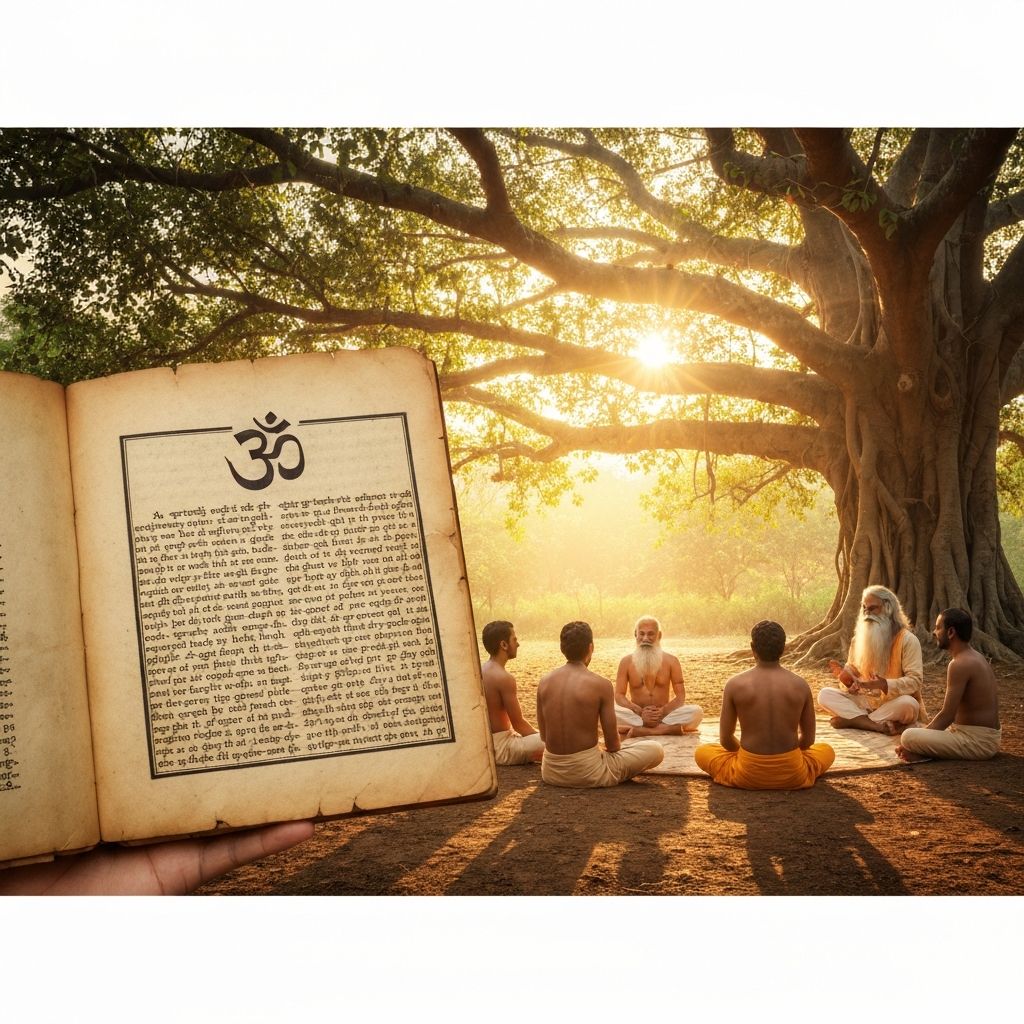
The Upanishads
The philosophical crown of the Vedas — exploring the nature of Brahman, Atman, and the ultimate questions of existence that have shaped Indian thought for millennia.
Composed
c. 800–200 BCE
Language
Sanskrit
Read Time
10 min read
The Upanishads mark a revolution in human thought. Emerging from the ritualistic world of the early Vedas, they shifted the focus from external sacrifice to internal inquiry, from appeasing gods to understanding the nature of reality itself. The questions they asked — Who am I? What is the nature of consciousness? What remains after death? — established the philosophical foundations not only of Hinduism but of much of world philosophy.
The Meaning of Upanishad
The word upanishad is traditionally interpreted as "sitting down near" — the student sitting at the feet of the teacher to receive secret teachings. This etymology captures the essence of these texts: they are not for public recitation but for intimate transmission from guru to shishya, revealing truths too subtle for the unprepared mind.
The Upanishads form the concluding portions of the Vedas and are therefore also called Vedanta — the end of the Vedas. While over 200 texts bear the name Upanishad, tradition recognises 108 as authentic, and of these, 10 to 13 are considered the principal or mukhya Upanishads, commented upon by all major Indian philosophers.
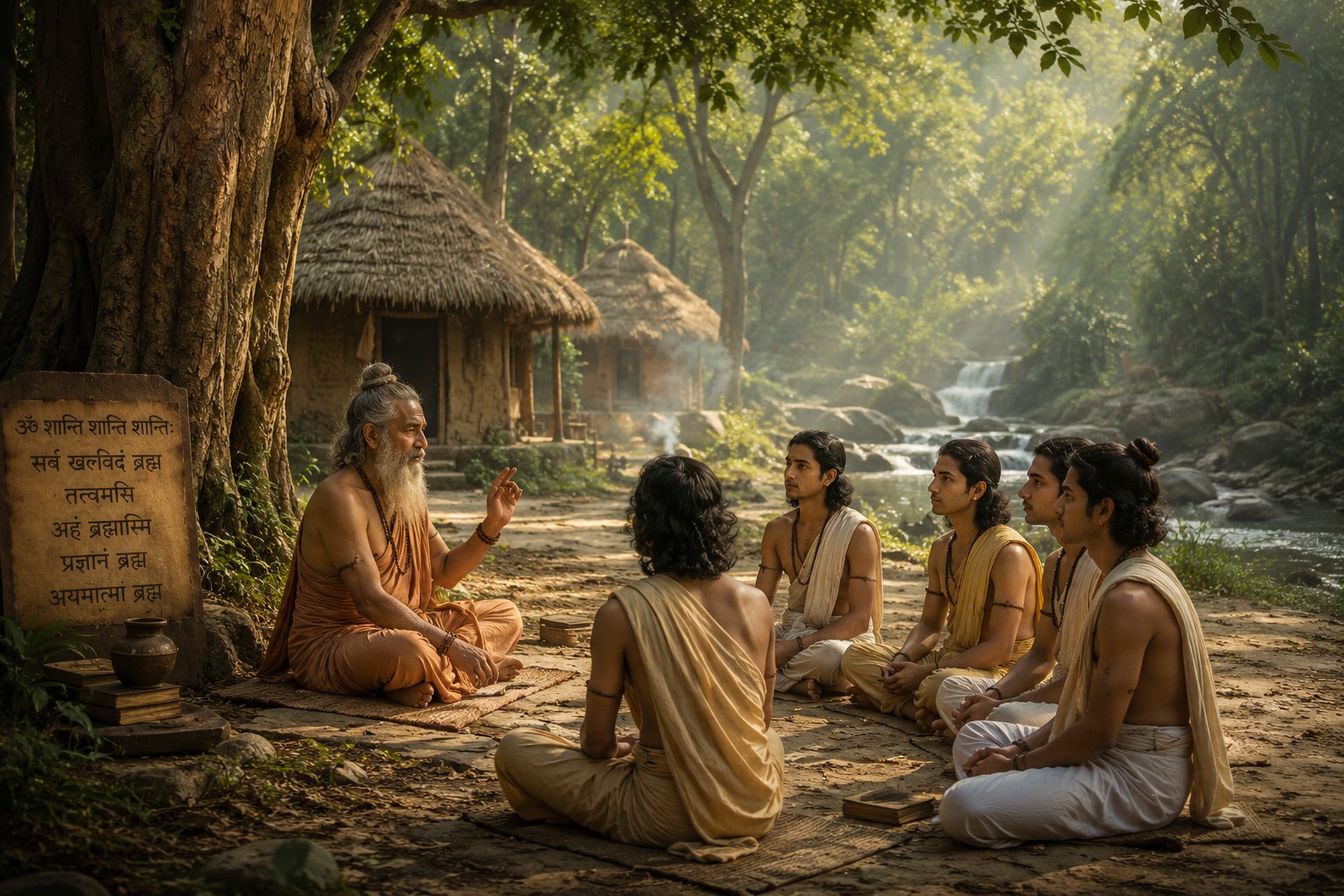
The Upanishadic tradition: secret teachings transmitted from guru to student in forest hermitages
The Central Teaching: Atman is Brahman
At the heart of Upanishadic teaching lies a single, revolutionary insight: the individual self (Atman) is not separate from the ultimate reality (Brahman). The sense of being a limited, separate individual is a form of ignorance (avidya); liberation (moksha) comes through direct knowledge of one's true nature as infinite, eternal consciousness.
This teaching is crystallised in the four mahavakyas (great statements), one from each Veda: Prajnanam Brahma (Consciousness is Brahman), Aham Brahmasmi (I am Brahman), Tat tvam asi (That thou art), and Ayam Atma Brahma (This Self is Brahman). These are not claims to be believed but pointers to be realised through direct inquiry and meditation.
The Principal Upanishads
Each of the principal Upanishads offers a unique doorway into the same ultimate truth, using different metaphors, dialogues, and approaches suited to different temperaments.
Brihadaranyaka Upanishad
Great Forest Teaching · Shukla Yajurveda
The longest and oldest of the principal Upanishads, it explores the nature of Brahman through profound dialogues. It contains the famous teaching of Yajnavalkya to his wife Maitreyi on the nature of the Self, and the declaration 'Aham Brahmasmi' — I am Brahman.
Notable: Contains the earliest systematic exploration of the Atman-Brahman identity and the doctrine of the five sheaths (koshas).
Chandogya Upanishad
Of the Chandas (Metre) Singers · Samaveda
Famous for its dialogue between the sage Uddalaka and his son Shvetaketu, teaching the fundamental identity of the individual self with ultimate reality through the repeated refrain 'Tat tvam asi' — That thou art.
Notable: The mahavakya 'Tat tvam asi' became one of the foundational statements of Advaita Vedanta philosophy.
Mandukya Upanishad
Of the Frog · Atharvaveda
The shortest of the principal Upanishads with just 12 verses, yet considered the most profound. It analyses the sacred syllable Om and describes the four states of consciousness — waking, dreaming, deep sleep, and the transcendent fourth (turiya).
Notable: Gaudapada's commentary (Karika) on this text established the philosophical foundations of Advaita Vedanta.
Katha Upanishad
Of the Katha School · Krishna Yajurveda
A dramatic dialogue between the young boy Nachiketa and Yama, the god of death. Nachiketa asks about the mystery of what happens after death, and Yama reveals the secret of the immortal Self hidden in the heart of all beings.
Notable: Its chariot metaphor — the body as chariot, intellect as driver, mind as reins — influenced the Bhagavad Gita.
Isha Upanishad
The Lord · Shukla Yajurveda
Beginning with the declaration that the Lord pervades all that exists, this brief Upanishad teaches the synthesis of knowledge and action, renunciation and engagement. Its 18 verses offer a complete philosophy of living in the world while remaining spiritually free.
Notable: Mahatma Gandhi called it the essence of Hinduism and said if all scriptures were lost, this one would suffice.
Kena Upanishad
By Whom · Samaveda
Named after its opening question — 'By whom directed does the mind move?' — this Upanishad explores the power behind all faculties of perception and action, identifying Brahman as the ultimate source that cannot itself be known as an object.
Notable: Contains the famous parable of Uma teaching the gods the nature of Brahman.
The Method: Neti Neti
The Upanishads employ a distinctive method of inquiry: neti neti — "not this, not this." Since Brahman cannot be grasped as an object of thought or described in positive terms, the seeker proceeds by negation — eliminating everything that can be perceived or conceived until only the perceiver remains. The body is not the Self. The mind is not the Self. Even the ego-sense is not the Self. What remains when all objects are negated is pure awareness — and that, the Upanishads declare, is Brahman.
"That which cannot be seen by the eye, but by which the eye sees — know that alone to be Brahman, not what people worship as an object."
Global Influence
When the Upanishads were first translated into Persian in the 17th century, and then into Latin and German in the 19th, they electrified Western philosophy. Schopenhauer called them "the most rewarding and elevating reading possible in the world" and kept the Latin translation by his bedside until his death. Through the Transcendentalists — Emerson, Thoreau, Whitman — Upanishadic ideas entered the American consciousness.
In India, Adi Shankaracharya's 8th-century commentaries on the Upanishads established Advaita Vedanta as the dominant school of Hindu philosophy. His interpretation — that the world is ultimately unreal (maya) and only Brahman exists — has been both celebrated and debated for over a millennium.
The Enduring Legacy
- The concept of Atman influenced Buddhist and Jain philosophy, even through critique and reformulation
- The Upanishadic teaching of inner divinity shaped Bhakti and Sufi mysticism in India
- Modern physics has drawn parallels between quantum mechanics and Upanishadic descriptions of reality
- Swami Vivekananda's Vedanta brought Upanishadic teachings to global audiences from 1893 onward
- Contemporary mindfulness and consciousness studies continue to engage with Upanishadic insights
The Upanishads do not ask to be believed. They ask to be investigated. Their invitation remains open after three millennia: turn attention inward, inquire into the nature of the one who perceives, and discover what remains when all that is not-Self falls away. That discovery, they promise, is freedom itself.