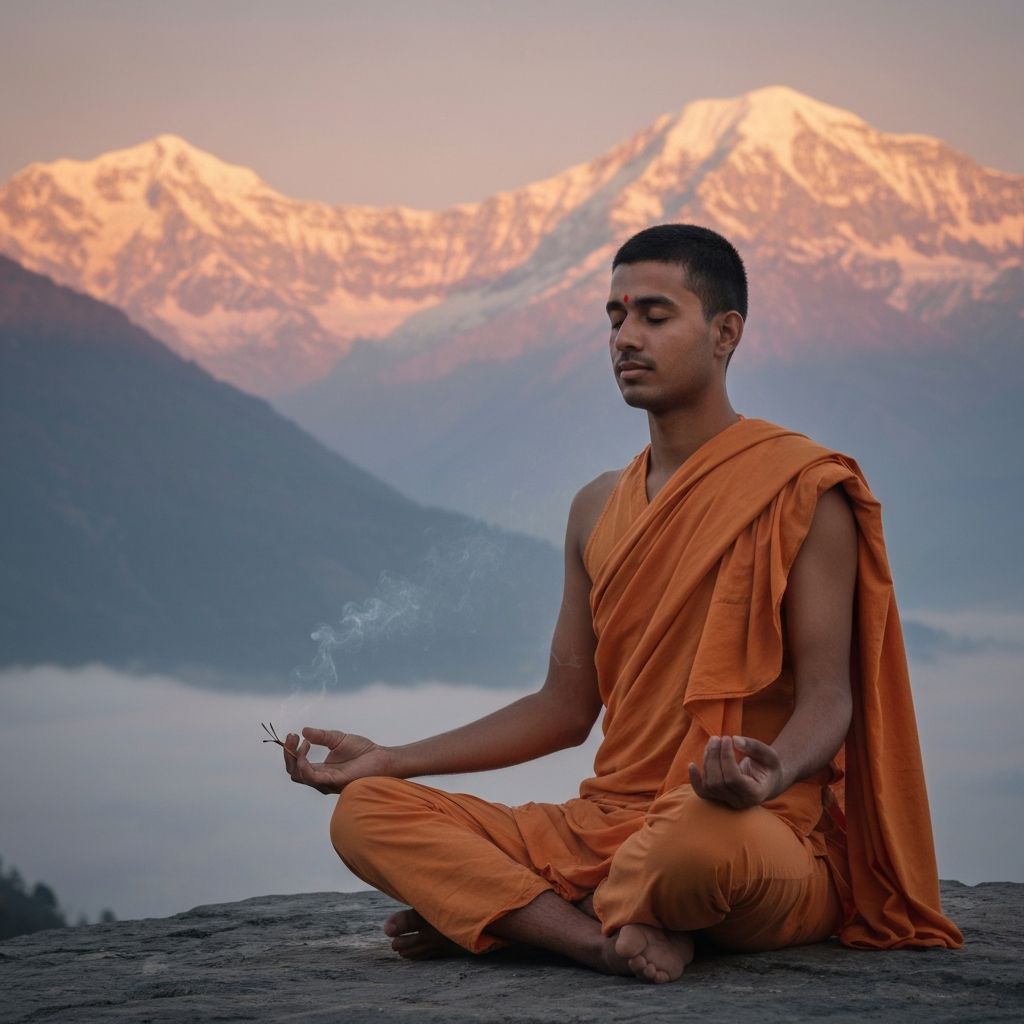
Meditation & Dhyana
The ancient Indian science of stilling the mind — from the forest sages of the Upanishads to the global mindfulness movement.
Origin
Vedic India, c. 1500 BCE
Tradition
Hinduism, Buddhism, Jainism
Read Time
7 min read
Long before the word "mindfulness" entered the modern vocabulary, the sages of ancient India had mapped the terrain of the human mind with extraordinary precision. They called it dhyana — a Sanskrit word that crossed into Chinese as chan and into Japanese as zen, eventually shaping contemplative traditions across the entire world.
The Roots: Vedic and Upanishadic Origins
The earliest references to meditative practice appear in the Rigveda, where the muni — solitary sages who wandered the forests — are described as entering altered states of consciousness through breath control and inward focus. By the time of the Upanishads (c. 800–200 BCE), meditation had been elevated to a sophisticated philosophical discipline. The Chandogya Upanishad describes dhyana as a higher form of thinking, while the Brihadaranyaka Upanishad connects it directly to the realisation of Brahman — the ultimate reality.
The Yoga Sutras of Patanjali, compiled around 400 CE, systematised these scattered practices into the famous eight-limbed path (Ashtanga Yoga). Dhyana appears as the seventh limb — the sustained, uninterrupted flow of attention towards an object — preceded by concentration (dharana) and followed by absorption (samadhi).
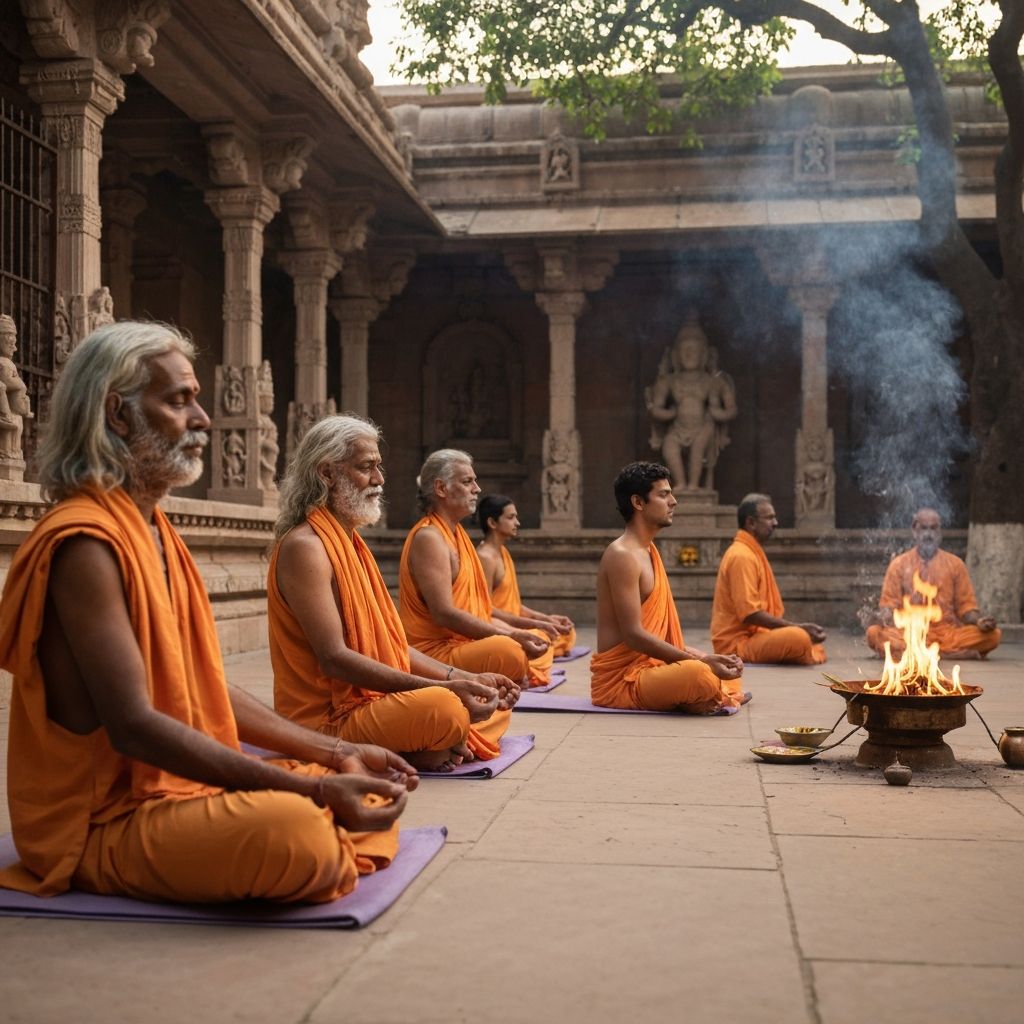
The tradition of communal meditation in forest hermitages goes back thousands of years
The Buddhist Contribution
Siddhartha Gautama, the historical Buddha, himself practised and taught meditation as the direct path to liberation. The Buddhist meditation traditions — samatha (calm abiding) and vipassana (insight) — became among the most rigorously documented contemplative systems in human history. The Pali Canon contains hundreds of pages of detailed meditation instructions, from the posture of the body to the quality of attention.
Particularly significant is the Satipatthana Sutta, the Discourse on the Foundations of Mindfulness, which laid out a complete framework for developing awareness of the body, feelings, mind, and phenomena. This text, over 2,500 years old, reads with striking relevance in the contemporary era of mindfulness-based therapies.
The Science of Stillness
Indian meditation traditions distinguished between many states: dharana (fixing attention), dhyana (sustained flow of attention), and samadhi (complete absorption). Within samadhi itself, classical texts describe a spectrum — from gross object-based absorption to formless, objectless states where the meditator rests in pure awareness itself.
The Kashmir Shaivite tradition, through texts like the Vigyan Bhairava Tantra, offered 112 distinct techniques — some using breath, some using visualisation, others using sensation or pure enquiry. This was not a one-size-fits-all approach, but a recognition that different minds require different doorways.
Key Classical Texts on Meditation
- Yoga Sutras of Patanjali — the definitive classical manual on the science of yoga and dhyana
- Vigyan Bhairava Tantra — 112 meditation techniques from Kashmir Shaivism
- Satipatthana Sutta — the Buddha's foundational discourse on mindfulness
- Mandukya Upanishad — on the four states of consciousness and turiya
- Hatha Yoga Pradipika — the 15th-century manual on breath and body practices
The Living Tradition
Meditation in India was never purely theoretical. Across the subcontinent, countless lineages preserved and transmitted these practices in unbroken chains of teacher and student. The Vipassana tradition of Mahasi Sayadaw and S.N. Goenka; the advaita-rooted self-inquiry of Ramana Maharshi; the kriya yoga of Paramahansa Yogananda; the Transcendental Meditation of Maharishi Mahesh Yogi — all represent distinct streams flowing from the same ancient source.
Today, as neuroscience begins to measure what meditators have always described — reduced activity in the default mode network, increased grey matter density, structural changes in the prefrontal cortex — the Indian tradition finds itself in a remarkable moment: ancient wisdom validated, and yet only beginning to be truly understood.
"When meditation is mastered, the mind is unwavering like the flame of a lamp in a windless place."
The practice of dhyana asks nothing more and nothing less than to sit still, to watch, and to know. In a world of relentless noise, this invitation — 5,000 years old — has never been more necessary.