Rajput School
Bold, lyrical, and deeply devotional — the visual poetry of Rajasthan's royal courts
Period
16th – 19th Century
Origin
Rajasthan
Style
Bold & Devotional
Sub-Schools
6+ Distinct Styles
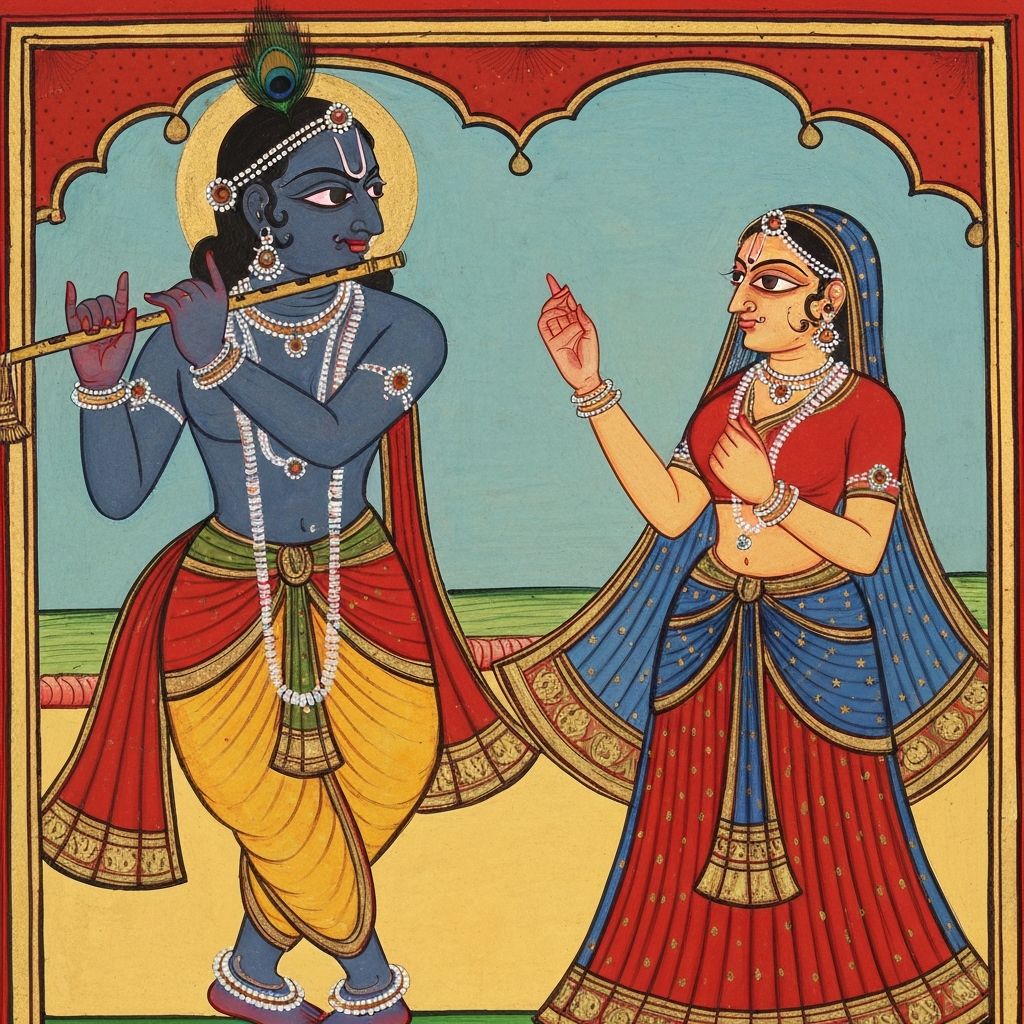
The Rajput School of miniature painting emerged in the royal courts of Rajasthan during the 16th century, developing a distinctive aesthetic that stood in contrast to the Mughal tradition. While Mughal painting emphasized realism and naturalism, Rajput art was bold, lyrical, and deeply devotional, drawing inspiration from Hindu mythology, poetry, and music.
These paintings are characterized by their vibrant colors, flat perspectives, and stylized figures. The primary subjects include the eternal love of Radha and Krishna, the musical modes of Ragamala, scenes from the Ramayana and Mahabharata, and the Baramasa (twelve months) series depicting seasonal activities.
Key Characteristics
Vibrant Bold Colors
Use of bright, saturated pigments like vermillion red, ultramarine blue, and deep yellow, creating visually striking compositions.
Flat Perspective
Unlike Mughal realism, Rajput paintings use a flat, two-dimensional perspective that emphasizes decorative elements.
Devotional Themes
Primary focus on Hindu religious subjects, especially the love stories of Radha and Krishna from the Bhagavata Purana.
Stylized Figures
Figures are idealized and stylized rather than realistic, with large almond-shaped eyes and graceful postures.
Popular Subjects
Major Sub-Schools
Mewar School
UdaipurBold lines and vivid colors; known for the Chawand Ragamala series (1605).
Bundi-Kota School
Bundi & KotaCelebrated for hunting scenes with lush natural settings and detailed fauna.
Kishangarh School
KishangarhFamous for elongated figures and the iconic Bani Thani portrait.
Marwar School
JodhpurStrong folk elements with bold outlines and flat color fields.
Jaipur School
JaipurInfluenced by Mughal style; more refined and realistic portraiture.
Bikaner School
BikanerDelicate brushwork combining Rajput and Mughal techniques.
Enduring Legacy
Today, Rajput miniature painting continues as a living tradition in cities like Jaipur, Udaipur, and Nathdwara. Artisans still use traditional materials — handmade paper, natural pigments, and squirrel-hair brushes — to create works that honor centuries of artistic heritage while finding new collectors worldwide.