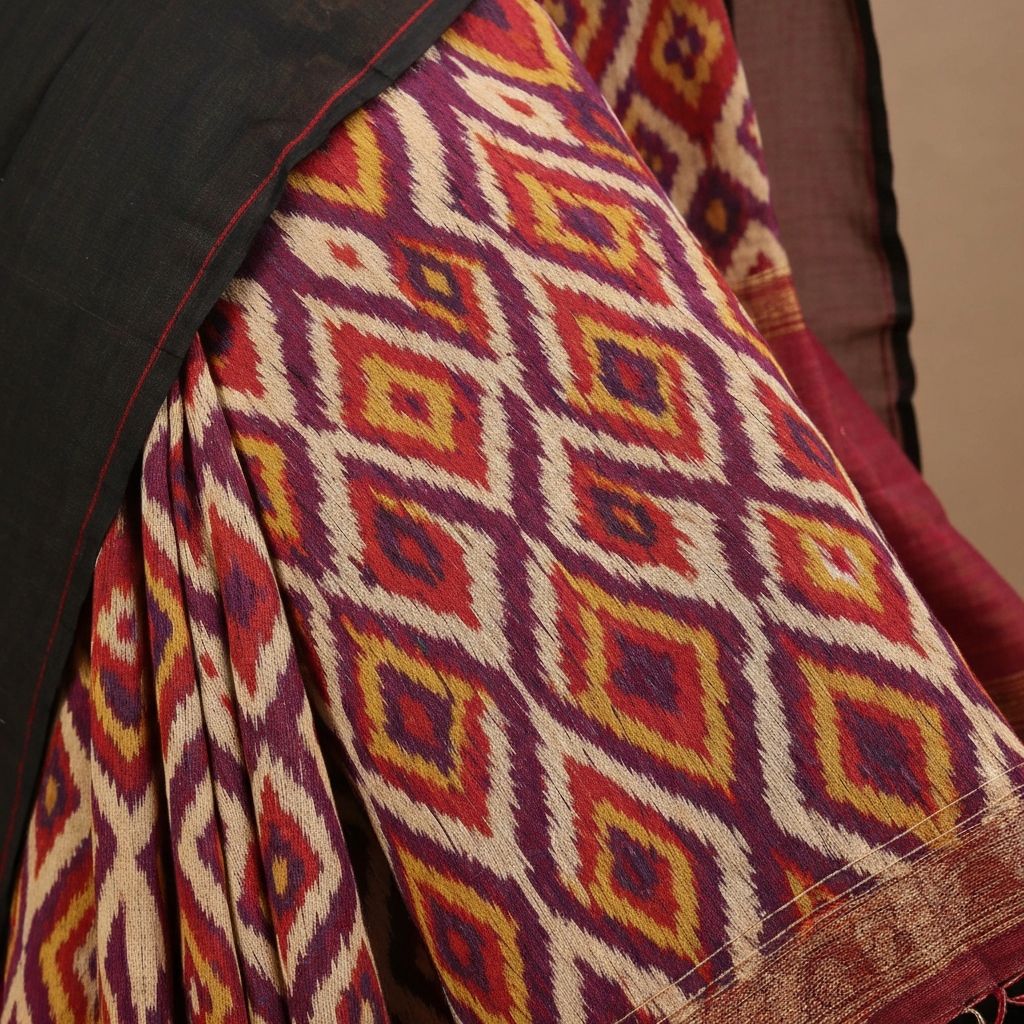
Pochampally Ikat
Where mathematics meets art — threads dyed in patterns that emerge only after weaving, creating mesmerizing geometric designs.
Origin
Pochampally, Telangana
History
500+ Years
Technique
Resist Dyeing & Weaving
Recognition
GI Tagged (2005)
Pochampally, a small town about 50 kilometers from Hyderabad, is home to one of the most mathematically precise textile traditions in the world. Ikat — derived from the Malay word "mengikat" meaning "to tie" — refers to a resist-dyeing technique where threads are carefully tied and dyed in patterns before being woven. The final design emerges only when the fabric is complete.
The process requires extraordinary precision. Weavers must calculate exactly where each thread will intersect on the loom, accounting for the natural stretching and movement of fibers. The characteristic "blurred" edges of ikat patterns aren't flaws — they're the signature of authentic handwork, where microscopic shifts in thread alignment create a soft, almost impressionistic effect.
Double ikat, where both warp and weft threads are dyed before weaving, is considered the pinnacle of the craft. Only a handful of weaving communities worldwide practice this technique, and Pochampally weavers are among the most skilled. UNESCO has recognized the town as a World Craft City, acknowledging its extraordinary contribution to textile heritage.
Distinctive Features
Resist-Dye Technique
Threads are tied and dyed before weaving
Blurred Edges
Characteristic soft edges from dye bleeding
Geometric Patterns
Diamonds, zigzags, and intricate angular designs
Double Ikat
Both warp and weft dyed for complex patterns
Vibrant Colors
Bold contrasts and rich color combinations
Handloom Weaving
Traditional pit looms create the signature texture
Varieties of Pochampally
Single Ikat
Either warp or weft is tie-dyed, simpler patterns
Double Ikat
Both warp and weft dyed, most complex and valuable
Silk Ikat
Luxurious mulberry silk base for formal occasions
Cotton Ikat
Everyday wear with traditional geometric patterns
Telia Rumal
Oil-treated cloth traditionally used by Gulf fishermen
Traditional Motifs
Identifying Authentic Pochampally
- Look for the GI tag and Handloom mark ensuring authenticity
- True ikat has soft, feathered edges on patterns — sharp edges indicate printing
- Both sides of authentic ikat show similar clarity of pattern
- Hand-woven fabric has slight irregularities in weave tension
- Thread-by-thread analysis shows dye penetration rather than surface printing
- Buy from certified cooperatives or government emporiums