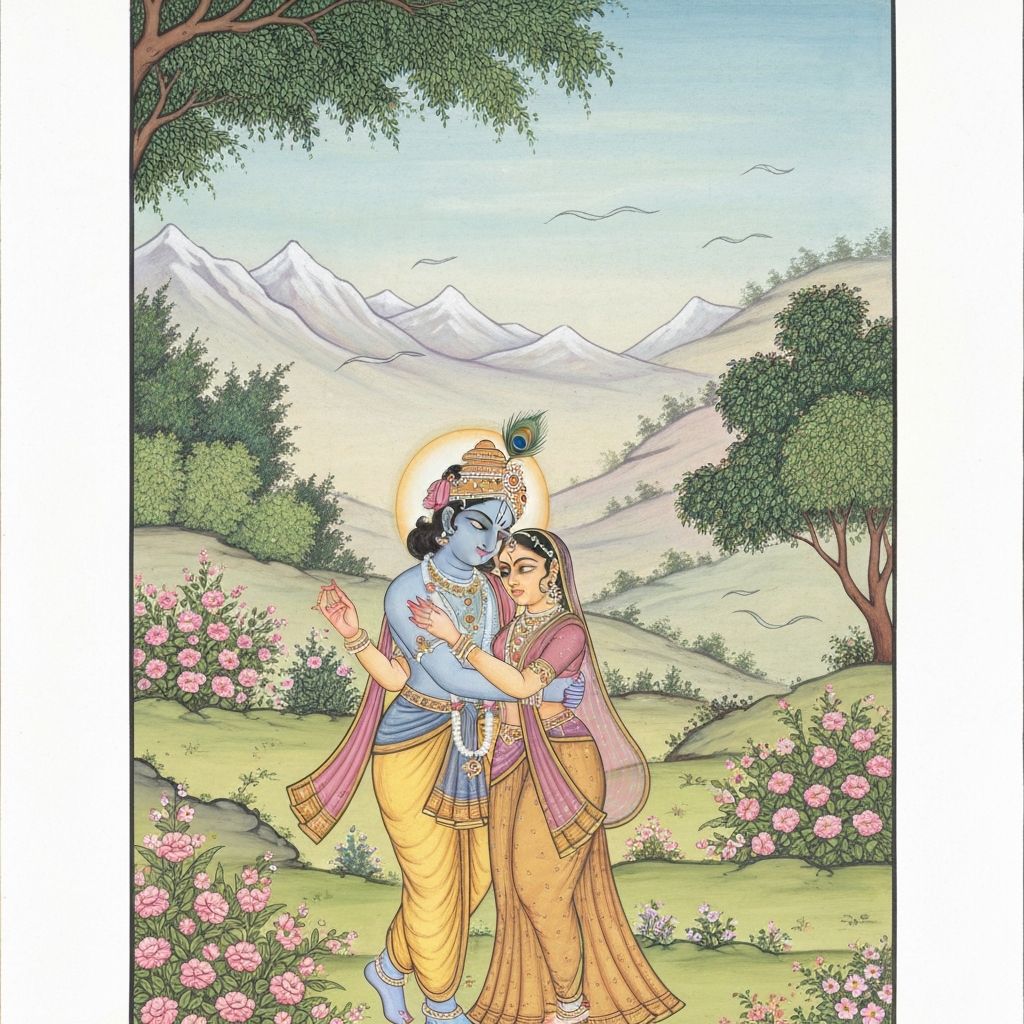
Pahari School
The lyrical art of the Himalayan hill courts — poetry painted in soft pastels and flowing lines
Period
17th – 19th Century
Origin
Himachal Pradesh, Jammu
Style
Lyrical & Romantic
Peak
Kangra Style
The Pahari School emerged from the small hill kingdoms (pahar means "hill") of the Himalayas during the 17th century. Unlike the boldness of Rajput painting or the realism of Mughal art, Pahari paintings are characterized by their lyrical quality, soft palette, and romantic sensibility.
The tradition flowered in courts from Basohli to Kangra, each developing distinctive styles. The Kangra School, reaching its zenith under Raja Sansar Chand (1775–1823), is considered the pinnacle of the tradition — its soft-toned depictions of Radha-Krishna romance remain among India's most beloved artistic achievements.
Key Characteristics
Lyrical Romanticism
Soft, poetic depictions of love, nature, and devotion, particularly the eternal romance of Radha and Krishna.
Delicate Line Work
Extremely fine brushwork with flowing, graceful lines that give figures an ethereal quality, especially in the Kangra style.
Naturalistic Landscapes
Beautiful mountain backdrops, flowering trees, and meandering streams reflecting the Himalayan environment.
Expressive Emotion
Faces convey deep feeling through subtle expressions, capturing the essence of devotional poetry and music.
Hill Court Styles
Basohli Style
1650–1750Bold, intense colors and strong facial expressions. Known for lotus-petal eyes and dramatic use of gold and silver.
Kangra Style
1765–1823The pinnacle of Pahari art. Soft pastel tones, delicate figures, and poetic romanticism in depictions of Krishna-Radha love.
Guler Style
1740–1780Transition between Basohli intensity and Kangra refinement. Known for naturalistic portraiture and landscape.
Chamba Style
18th centuryRelated to Kangra but with distinctive local variations. Famous for Rumal embroidery based on paintings.
Mandi Style
18th centuryUnique blend of folk vigor with courtly refinement. Bold outlines with local character types.
Kullu Style
17th–18th centuryFolk-influenced with simpler compositions and strong local religious themes.
Notable Pahari Painters
Manaku
Guler Style
Created the celebrated Gita Govinda series (c. 1730)
Nainsukh
Guler Style
Master of intimate portraiture; documented Raja Balwant Singh's life
Purkhu
Kangra Style
Refined the Kangra style under Raja Sansar Chand