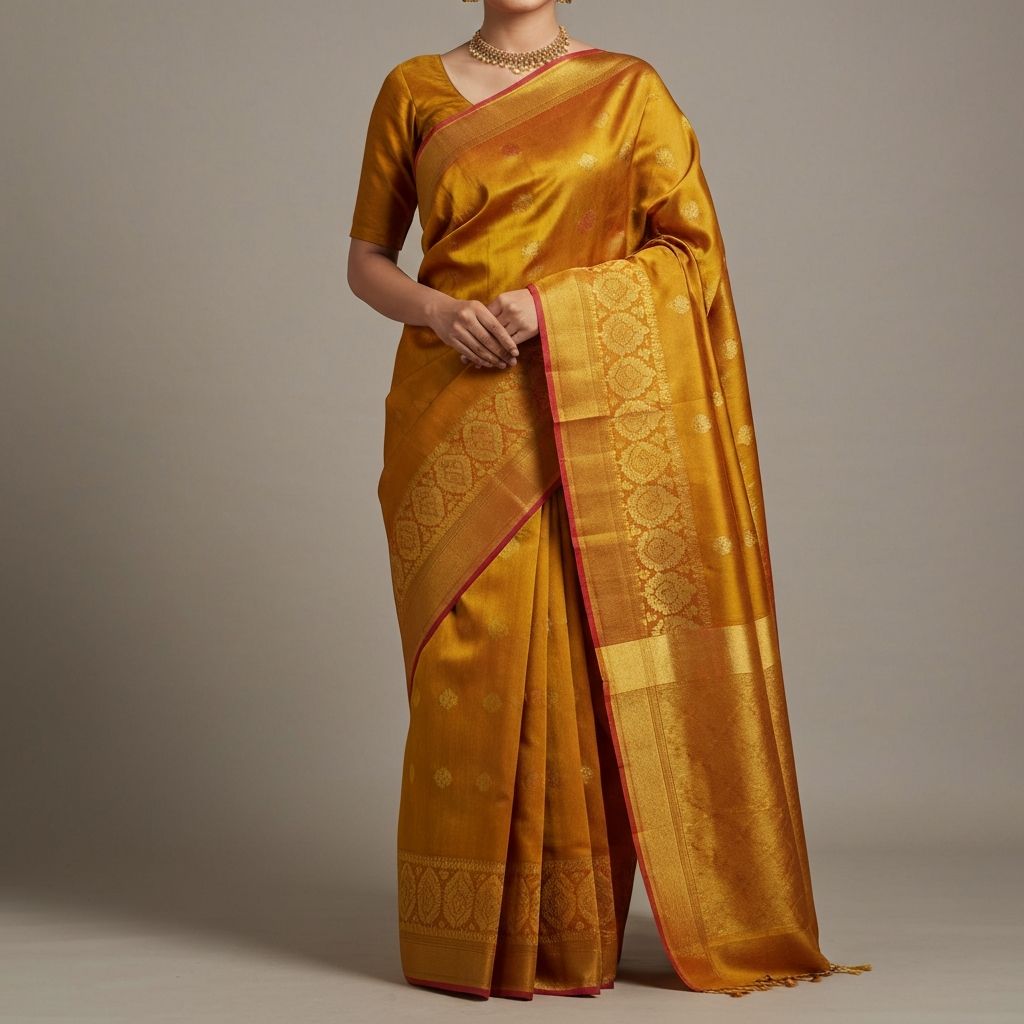
Muga Silk
The world's rarest silk — a golden treasure exclusive to Assam that grows more luminous with age.
Origin
Assam, Northeast India
History
600+ Years
Production
Semi-Wild Cultivation
Recognition
GI Tagged
In the misty valleys of the Brahmaputra, where monsoon rains nourish ancient Som and Soalu trees, a silkworm produces something found nowhere else on Earth. Muga silk — named from the Assamese word for amber — is the world's only naturally golden silk, and it can only be produced in Assam's unique ecosystem.
Unlike commercial mulberry silkworms that are fully domesticated, Muga silkworms (Antheraea assamensis) are semi-wild creatures. They cannot survive in captivity for long periods and must be reared outdoors on their host trees. This delicate relationship between insect, tree, and climate makes Muga production impossible to industrialize or relocate — ensuring its exclusivity and preciousness.
For centuries, Muga was reserved for Ahom royalty. Common people were forbidden from wearing it. Today, it remains among the most expensive textiles in the world, prized not just for its rarity but for a remarkable property: unlike other silks that fade with washing, Muga's golden sheen actually intensifies with each wash, developing a deeper, more luminous patina over decades.
What Makes Muga Special
Natural Golden Hue
Unique amber-gold color that cannot be replicated
Increasing Sheen
Lustrous finish that improves with every wash
Extreme Durability
Strongest natural fiber, lasting generations
Semi-Wild Production
Silkworms fed on Som and Soalu trees
Geographic Exclusivity
Only produced in Assam's Brahmaputra Valley
Royal Heritage
Reserved for Ahom royalty for centuries
Muga Products
Pure Muga Saree
Traditional Assamese Mekhela Chador in golden silk
Muga-Eri Blend
Combined with Eri silk for different textures
Muga Riha
The upper garment of traditional Assamese attire
Muga Chaddar
Traditional shawl worn by men and women
Contemporary Muga
Modern silhouettes in ancient golden silk
Traditional Assamese Motifs
Caring for Muga
- Wash gently by hand in cold water — Muga actually benefits from washing
- Use mild soap or shikakai, never harsh detergents
- Dry in shade to protect the fiber structure
- Iron on low heat while slightly damp
- Store wrapped in cotton cloth, never plastic
- The more you wear and wash it, the more it glows