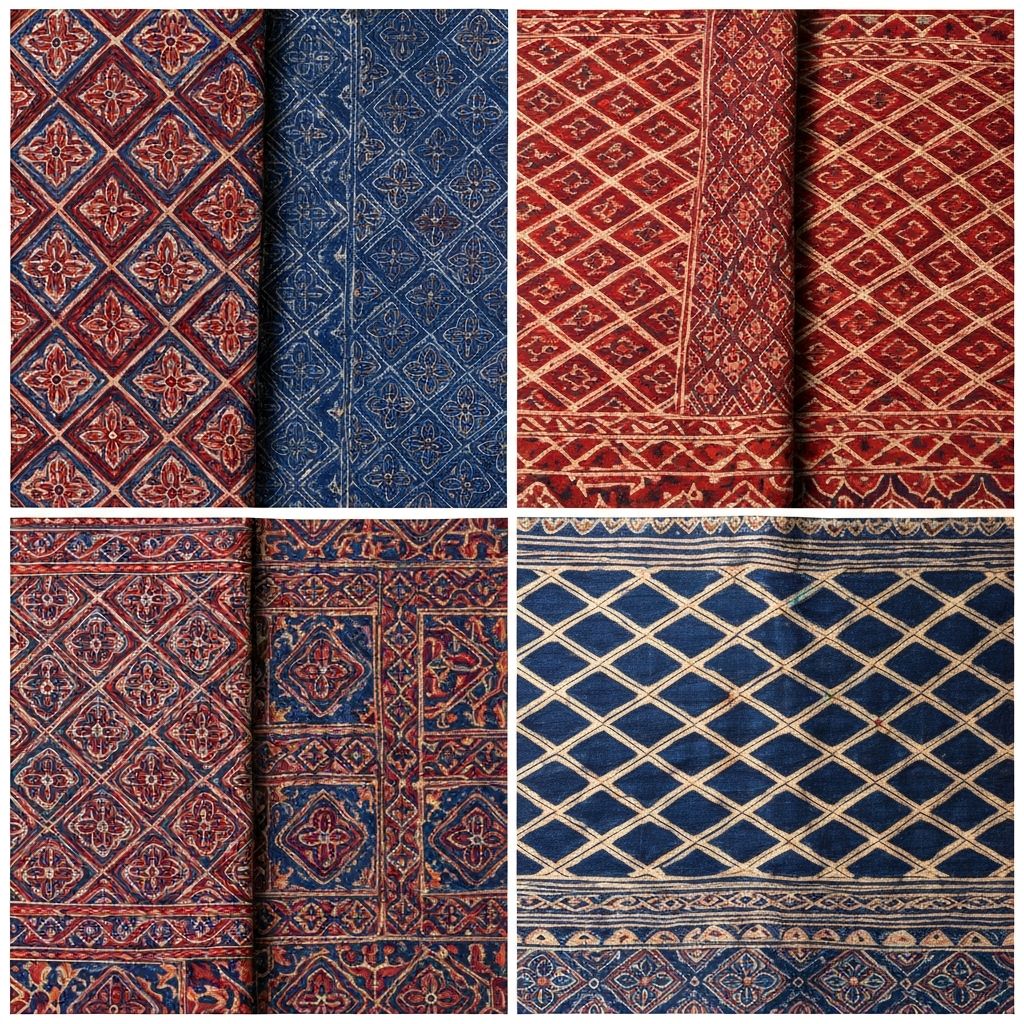
Ajrakh
Ancient geometry in indigo and red — a 4,000-year-old resist printing tradition that transforms cloth through 16 stages of cosmic precision.
Origin
Kutch, Gujarat & Sindh
History
4000+ Years
Technique
Resist Block Printing
Recognition
GI Tagged
Ajrakh is one of the most ancient and complex printing traditions in the world, with roots stretching back to the Indus Valley Civilization. Fragments of Ajrakh-like prints have been found at Mohenjo-daro, suggesting that the same geometric patterns being printed in Kutch today may have been worn 4,000 years ago.
The word "Ajrakh" is believed to derive from "azrak" (blue) or "ajar rakh" (keep today). Both interpretations capture the essence: blue is its soul color, derived from natural indigo, and the tradition itself has been kept alive, unchanged, across four millennia. The distinctive deep blue and madder red palette, combined with intricate geometric patterns, makes Ajrakh instantly recognizable.
Creating Ajrakh is a meditative, almost alchemical process. It involves 16 stages over 14-21 days, including multiple resist applications, dye baths, and sun-drying. The fabric is washed in the river, mordanted with castor oil, printed with mud resist, dipped in indigo vats, and dried under the desert sun. Each step must be performed at the right time, in the right conditions, for the colors to set correctly.
Distinctive Features
Resist Printing
Mud and wax resist patterns before dyeing
Natural Indigo
Deep blue from fermented indigo plant dye
Madder Red
Rich crimson from the roots of madder plant
Geometric Precision
Mathematical symmetry in pattern design
Double-Sided Print
Same pattern appears on both sides
16 Stages
Complex process taking 14-21 days
Ajrakh Patterns
Kark (Crab)
Central medallion design representing protection
Kakkar
Grid pattern with repeating geometric elements
Hasi (Elephant)
Auspicious elephant motifs symbolizing strength
Maldhari
Pastoral patterns from nomadic traditions
Indigo Solid
Deep blue with resist-printed white patterns
Double Print
Complex layering creating multi-color effects
Geometric Elements
Caring for Ajrakh
- First wash in cold water with a tablespoon of salt to set indigo
- Natural indigo will release color initially — wash alone for first 3-4 washes
- Hand wash gently, no harsh detergents or bleach
- Dry in shade — sun exposure can alter natural dye colors
- Colors will develop a beautiful patina with age and washing
- Authentic Ajrakh improves with time, becoming softer and more luminous